
Part 17
Supplements, Ranked by Evidence
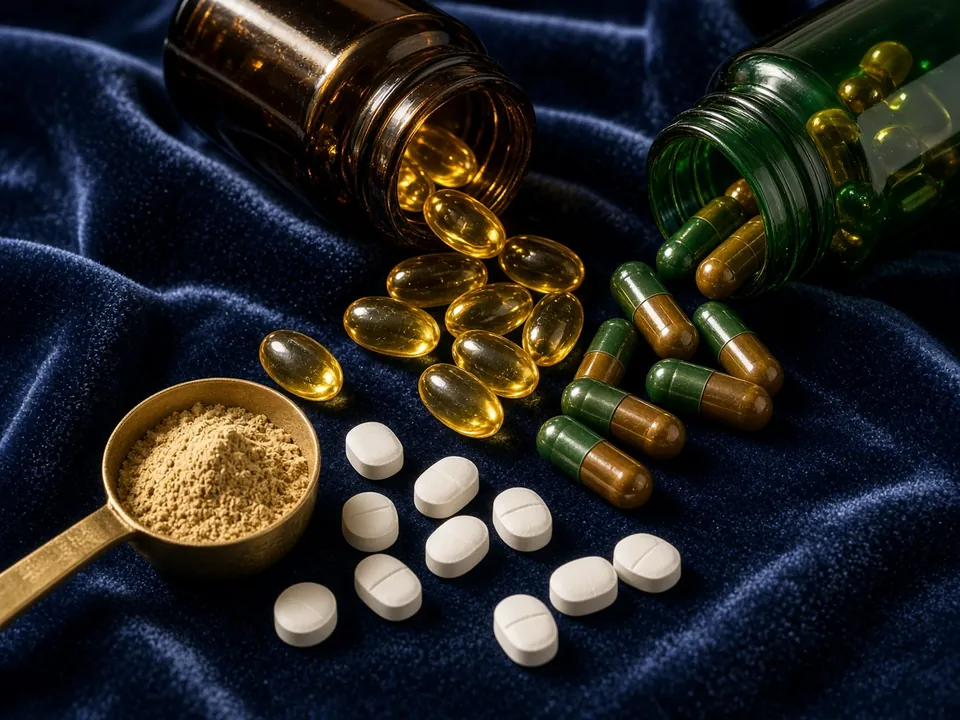
ILLUSTRATION. Picture a person bringing a long supplement list to an appointment: pills, peptides, devices, subscriptions. Before adding anything, the clinician asks about symptoms, medications, sleep, meals, and relationships. An impressive inventory can conceal an ordinary unmet need. The list deserves review; so does the life around it.
Clinical scenes in this edition are explicitly labeled illustrations. They describe imagined situations used to explain medical decisions, not documented patients, diagnoses, conversations, or treatment outcomes. They should not be read as evidence that a particular intervention works. Personal recollections are recollections, not medical records.
Evidence grade (draft mapping). 22 questions; a question with mixed evidence counts under each grade.
- 236. Has any supplement been proven to extend human life?No. Not one.FNot demonstrated / insufficient
- 237. How are supplements regulated?Loosely. In the United States, the FDA generally does not approve supplements for safety and effectiveness before sale. Manufacturers still have legal responsibilities for labeling, safety, and manufacturing standards, but that is different from premarket drug approval.RRegulatory status
- 238. How should I decide what to take?Test, correct what is low, add only what has human evidence for your specific goal, and review the list once a year.JClinical judgment / author synthesis
- 239. Which supplements do you take yourself?Seven, counting vitamin D3 with K2 as one. I take them as a system, not as a collection, and I have a reason for each.JClinical judgment / author synthesis
- 240. Creatine: is it only for bodybuilders?No. It is the best-studied performance supplement in existence, and it is particularly useful for older adults who lift weights.ARobust human trials
- 241. Can creatine help me keep muscle even if I am not exercising?Creatine without training has inconsistent evidence for preserving useful muscle function. It should not be presented as a reliable substitute for resistance exercise.BLimited or small human studies
- 242. Vitamin D: should everyone take it?No. Treat established deficiency and specific clinical indications. For generally healthy people, routine testing and a universal “optimal” blood target are not supported.GGuideline-based / consensus
- 243. Why vitamin K2 with vitamin D?The theory is sound: vitamin D raises calcium absorption, and K2 helps direct calcium into bone and away from arteries. The proof that this prevents heart disease or fractures is not there yet.DPreclinical / mechanistic
- 244. Fish oil: yes or no?Eat fish twice a week. Take prescription-strength omega-3 if your triglycerides are high and your cardiologist advises it. Ordinary capsules for healthy people have shown little.ARobust human trials
- 245. Magnesium: who needs it?Meet your magnesium needs through food when possible. Supplement for a reason, rather than assuming that everyone with insomnia or cramps is deficient.BLimited or small human studies
- 246. Should I take a daily multivitamin?It is not essential, but for adults over 60 the evidence has become more favorable.Grade pending
- 247. What is NAD, and do NMN and NR work?NAD is a molecule every cell uses to make energy and repair DNA, and it declines with age. NMN and NR reliably raise NAD in blood. Whether that makes people healthier is still unproven.Grade pending
- 248. What is urolithin A?A compound your gut bacteria make from pomegranates and walnuts, sold as a supplement to help cells recycle worn-out mitochondria. Small human trials show modest gains in muscle endurance and strength.BLimited or small human studies
- 249. What is GlyNAC?A combination of two amino acids, glycine and N-acetylcysteine, that the body uses to make glutathione, its main internal antioxidant. Results from small trials are striking and need to be repeated.BLimited or small human studies
- 250. Is CoQ10 worth taking?For heart failure, possibly. For people on statins with muscle aches, I do not object to a trial of it; the studies are inconsistent and the risk is negligible. For general longevity, there is no evidence.BLimited or small human studies
- 251. What about spermidine, taurine, and curcumin?Each has an appealing story in the laboratory and weak or negative human trials so far.DPreclinical / mechanistic
- 252. Resveratrol was the original longevity supplement. What happened?It failed. It did not extend life in normal mice, human trials were disappointing, and the drug company that bought the idea abandoned it.FNot demonstrated / insufficient
- 253. Is berberine “nature’s Ozempic”?No. Berberine modestly lowers blood sugar and LDL cholesterol. It does not produce meaningful weight loss.BLimited or small human studies
- 254. Are protein powder and collagen worthwhile?Protein powder is a convenience food, and a good one if you struggle to reach your target. Collagen has modest evidence for skin and joints and is a poor protein for building muscle.ARobust human trialsBLimited or small human studies
- 255. Is psyllium fiber worth taking?Yes. It is one of the few supplements with an FDA-authorized heart health claim.ARobust human trials
- 256. What about nattokinase and niacin for the heart?Nattokinase is interesting and unproven. Niacin I no longer recommend.BLimited or small human studies
- 257. Which supplements can actually hurt me?High-dose vitamin E, beta-carotene in smokers, too much calcium in pills, excess vitamin A, and herbal blends that affect the liver or interact with medicines.ARobust human trials